Introduction: A Colourful Classroom Is More Than a Beautiful Classroom
Imagine entering two classrooms.
The first classroom has plain walls, ordinary teaching materials and very few visual learning resources.
The second classroom has colourful number cards, picture charts, learning corners, attractive word walls and student-created artwork.
Which classroom might immediately capture a young child’s curiosity?
For many children, colourful learning materials can make a classroom feel inviting and interesting. However, the real educational value of colour goes far beyond decoration.
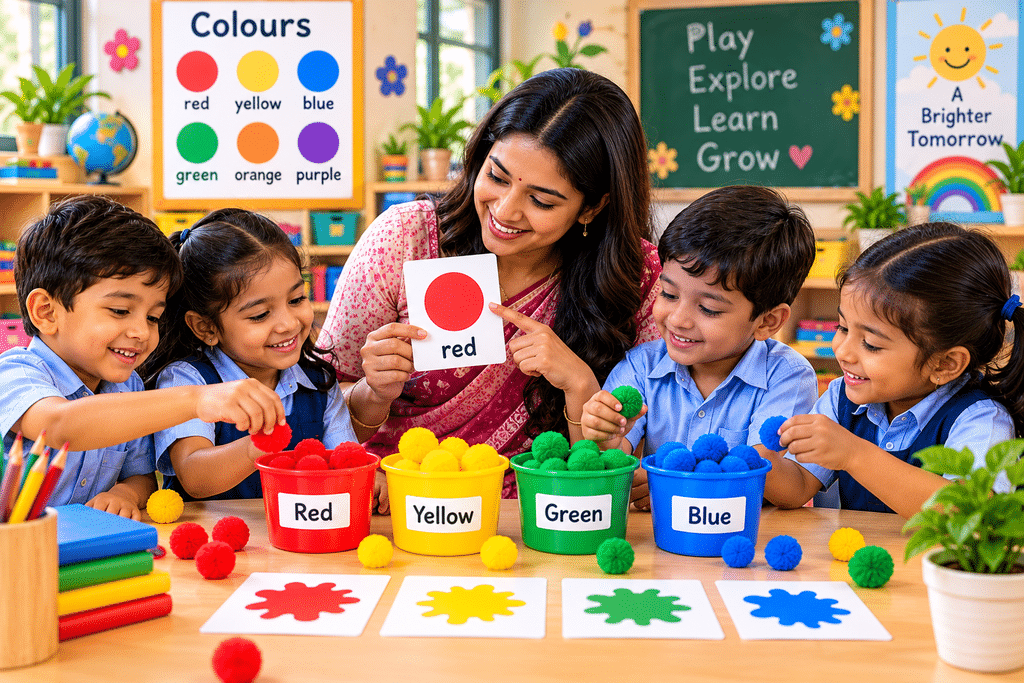
Colours can become powerful teaching tools when teachers use them purposefully.
A red circle can introduce shapes. A green leaf can begin a science discussion. A blue number card can help children recognise mathematical patterns. Colour-coded word cards can make sentence-building activities easier to organise.
Colours are especially useful in early childhood and primary education because children often learn through observation, movement, play, exploration and hands-on experiences.
But an important distinction must be understood: simply adding more colours does not automatically improve learning. Effective colour use depends on the child’s age, the lesson objective, visual clarity and individual learning needs.
Let us explore ten meaningful ways teachers can use colours to create engaging, inclusive and developmentally appropriate learning experiences.
1. Colours Help Capture Children’s Attention
Young children are naturally curious about noticeable changes in their surroundings.
A colourful object, contrasting picture or visually clear flashcard may attract attention and encourage children to explore.
For example, during a mathematics lesson, a teacher can use three differently coloured baskets to introduce sorting and counting.
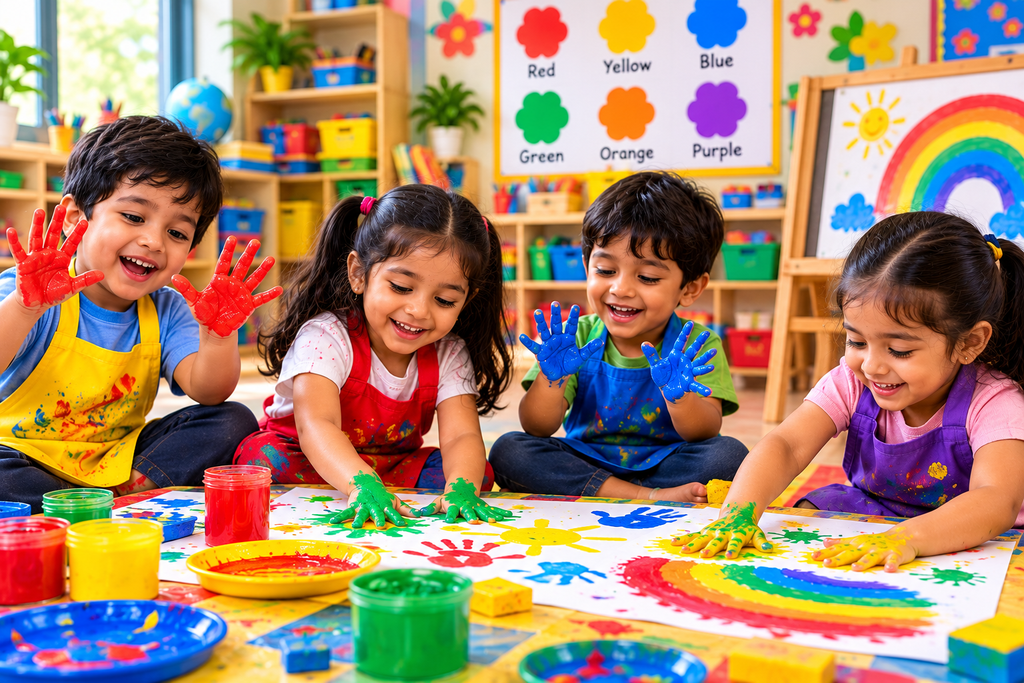
Classroom Activity: Colour Sorting Station
Materials:
- Red, yellow, green and blue paper cups
- Coloured bottle caps or paper circles
- Four colour-label cards
Ask children to place each object in the matching container.
Extend the activity by asking:
- Which container has the most objects?
- Which colour has the fewest?
- Can you arrange the colours in a pattern?
Learning outcomes: Colour recognition, attention, classification and early numeracy.
Teacher’s Tip: Use colour to highlight important information, not to decorate every available space.
2. Colours Can Support Memory and Recall
Colours can act as visual cues that help children organise and retrieve information.
When a teacher consistently uses particular colours for categories or classroom routines, children may find it easier to remember where information belongs.
For example, vocabulary cards can use one colour for nouns and another for verbs.
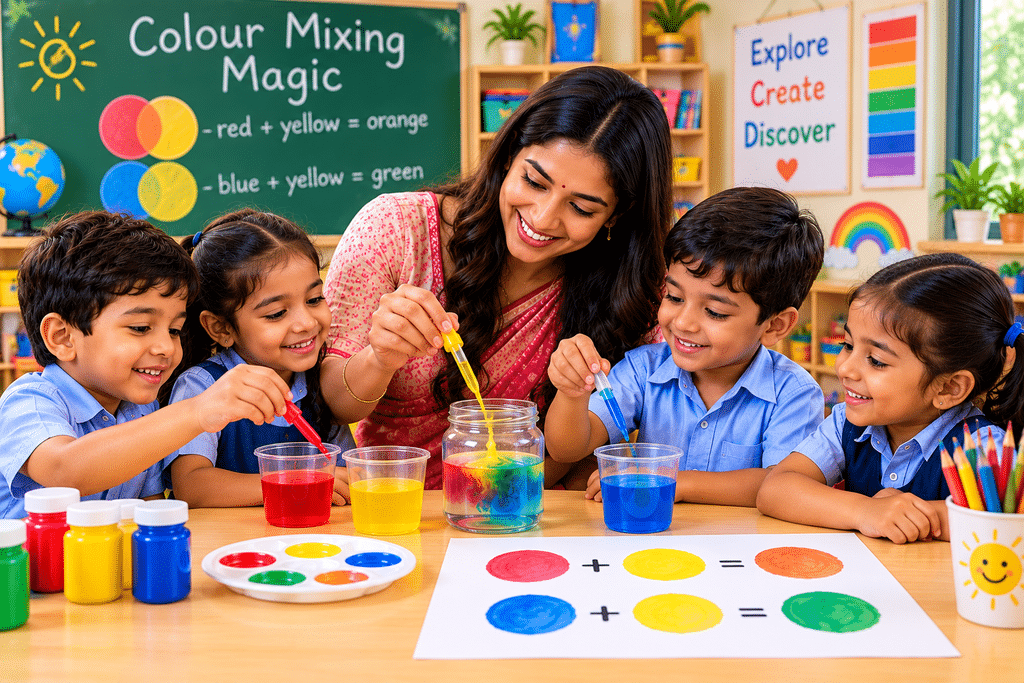
Classroom Activity: Colour-Coded Word Families
Prepare word cards:
- Blue: Naming words
- Green: Action words
- Yellow: Describing words
Children choose cards and construct simple sentences.
Example:
Birds + fly + high.
Once children understand the categories, gradually remove the colour cues to check whether they can identify the words independently.
Learning outcomes: Vocabulary development, classification, sentence formation and recall.
3. Colours Make Abstract Concepts Easier to Explore
Some concepts are difficult for young learners to understand through verbal explanation alone.
Colours can provide visible distinctions that support demonstrations of mathematical and scientific ideas.
Teachers can use coloured paper strips to compare lengths, coloured counters to model addition, or different colours to distinguish parts of a diagram.
Classroom Activity: Rainbow Fractions
Give children a paper circle divided into equal sections.
Use different colours to represent the parts.
Ask:
- How many equal parts are there?
- What fraction is coloured red?
- How many parts remain uncoloured?
Learning outcomes: Understanding parts of a whole, fractions and visual representation.
4. Colours Encourage Creativity and Imagination
Artistic exploration gives children opportunities to experiment, make choices and express ideas.
When children combine colours, create pictures or invent designs, they practise flexible thinking.
Importantly, creativity should not be limited to producing realistic pictures.
A purple tree or an orange river can be part of a child’s imaginative story.
Classroom Activity: My Imaginary Colourful World
Ask children to draw a place that does not exist in the real world.
Encourage them to explain:
- What makes this place special?
- Why did they choose these colours?
- Who lives there?
Learning outcomes: Creativity, storytelling, communication and self-expression.
5. Colours Support Classroom Organisation
Colour coding can make classroom materials and routines easier to manage.
Teachers can assign colours to different learning stations, subject folders, activity groups or storage containers.
For example:
| Colour | Classroom Use |
|---|---|
| Blue | Mathematics materials |
| Green | Environmental Studies |
| Yellow | Reading activities |
| Orange | Art and craft |
| Purple | Puzzle corner |
Always include written labels or pictures so that children are not dependent on colour alone.
Classroom Activity: Find Your Learning Station
Give each group a picture-and-colour activity card. Children identify their station, collect the materials and begin their task.
Learning outcomes: Independence, responsibility and organisational skills.
6. Colours Support Multisensory and Inclusive Learning
Children learn in different ways and may need different types of support.
Colourful learning materials can be combined with touching, movement, speaking, listening and manipulating objects.
For example, children can form letters using coloured clay while saying their sounds aloud.
This is more meaningful than relying on colour alone.
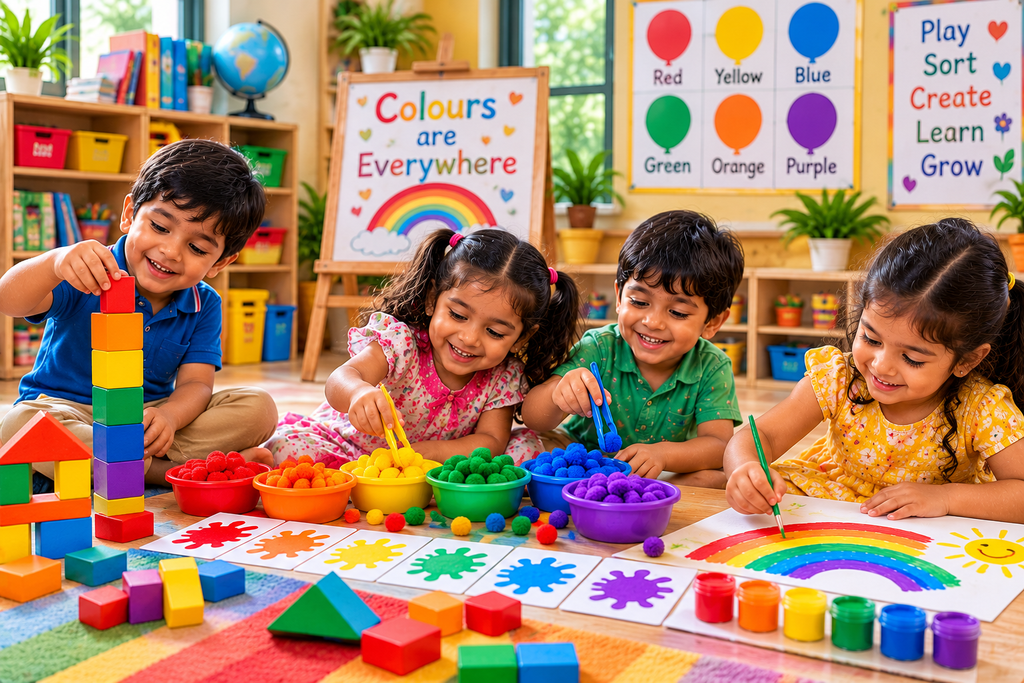
Classroom Activity: Touch, Say and Match
Provide large textured alphabet cards, matching pictures and letter sounds.
Children touch a letter, say its sound and match it with an object.
Learning outcomes: Letter recognition, sound awareness, sensory exploration and coordination.
Inclusive Teaching Note: Some children have colour-vision differences or visual sensitivities. Use strong contrast, simple backgrounds, clear symbols and verbal instructions alongside colour.
7. Colours Can Create an Inviting Learning Environment
A welcoming classroom can encourage children to participate in activities.
Colourful student artwork, clearly organised learning displays and thoughtfully designed classroom corners can contribute to a positive atmosphere.
However, excessive decoration may distract some children, especially during tasks requiring concentration.
Classroom Activity: Our Classroom Colour Garden
Give every child a paper flower.
Children decorate their flowers and write or draw something they enjoy learning.
Arrange the flowers into a classroom garden display.
Learning outcomes: Participation, belonging, communication and classroom ownership.
8. Colours Help Develop Early Literacy and Numeracy
Colour-based games can introduce important pre-reading and pre-mathematical skills.
For literacy, children can identify coloured letter cards, match beginning sounds and build words.
For numeracy, they can create patterns, sort counters, count objects and compare groups.
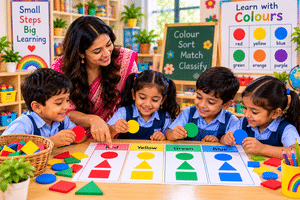
Classroom Activity: Colour Pattern Detectives
Create patterns such as:
Red – Blue – Red – Blue – ___
Yellow – Green – Green – Yellow – Green – Green – ___
Ask children to identify and extend each pattern.
Challenge older children to invent their own repeating patterns.
Learning outcomes: Pattern recognition, sequencing, prediction and mathematical reasoning.
9. Colours Encourage Observation and Scientific Thinking
Colours provide excellent starting points for environmental exploration.
Children can observe flowers, fruits, vegetables, soil, leaves, insects and seasonal changes.
Teachers can encourage careful observation rather than simply asking children to name colours.
Classroom Activity: Nature Colour Detectives
Take children on a supervised walk around the school.
Give them a simple observation sheet.
Ask them to find:
- Two green objects
- One brown object
- One object with multiple colours
- One object whose colour changes over time
Discuss what they noticed.
Learning outcomes: Observation, comparison, environmental awareness and descriptive language.
10. Colours Can Support Inclusive Participation and Confidence
Colour-based activities often allow children to participate before they have developed strong reading or writing skills.
A child who struggles to write a sentence may still be able to classify objects, create a pattern, build a model or explain a picture.
These opportunities can help children experience success.
Classroom Activity: Everyone Creates a Rainbow
Give groups different materials such as coloured paper, leaves, fabric scraps and bottle caps.
Ask them to create a rainbow-inspired collaborative artwork.
Allow each child to contribute in a way that suits their abilities.
Learning outcomes: Collaboration, creativity, participation and confidence.
10 Additional Fun Colour Activities for Primary Classrooms
| Activity | Suggested Classes | Main Learning Area |
|---|---|---|
| Colour scavenger hunt | 1–3 | Observation and vocabulary |
| Rainbow number line | 1–3 | Number sequencing |
| Colour-coded sentence building | 2–5 | Language |
| Colour mixing experiment | 1–5 | Science and art |
| Pattern bracelet making | 1–4 | Mathematics |
| Rainbow fraction wheel | 3–5 | Fractions |
| Colour and emotion discussion | 1–5 | Social-emotional learning |
| Nature colour journal | 2–5 | EVS |
| Colourful shape city | 1–4 | Geometry |
| Recycled-material colour collage | 1–5 | Art and environmental awareness |
How to Use Colours Effectively in Multigrade Classrooms
In a multigrade classroom, teachers often teach children of different ages and learning levels simultaneously.
Colour coding can help organise differentiated activities.
For example, during a mathematics period:
Class 3: Sort and count coloured objects.
Class 4: Create and explain repeating colour patterns.
Class 5: Use coloured grids to represent fractions and compare quantities.
All three groups work with a common theme while practising different competencies.
Teachers can prepare low-cost materials from recycled cardboard, old calendars, coloured paper and clean bottle caps.
Common Mistakes Teachers Should Avoid
Colourful learning resources are useful only when they support the learning objective.
Avoid overcrowding charts with unnecessary illustrations, using too many competing colours, relying on colour as the only way to communicate information, and assuming that every child responds to colours in the same way.
Also avoid treating particular colours as scientifically guaranteed to improve intelligence, memory or behaviour.
Purposeful colour selection matters more than the number of colours used.
Frequently Asked Questions
1. Why are colours important in early childhood education?
Colours can support observation, classification, vocabulary, creativity and early mathematical exploration when used through meaningful activities.
2. Do colourful classrooms improve academic performance?
Not automatically. Well-designed visual materials may support particular learning tasks, while excessive decoration can sometimes become distracting.
3. Which colours are best for teaching children?
There is no universally best colour. Teachers should prioritise readability, contrast, consistency, accessibility and the specific learning objective.
4. Can colours help children with learning difficulties?
Colour cues may help some children organise information, but they should be combined with appropriate teaching strategies and individual support.
5. How can teachers make low-cost colour teaching materials?
Teachers can use coloured paper, fabric scraps, cardboard, natural materials, reusable containers and recycled objects.
Conclusion: Teach With Colours, Not Just About Colours
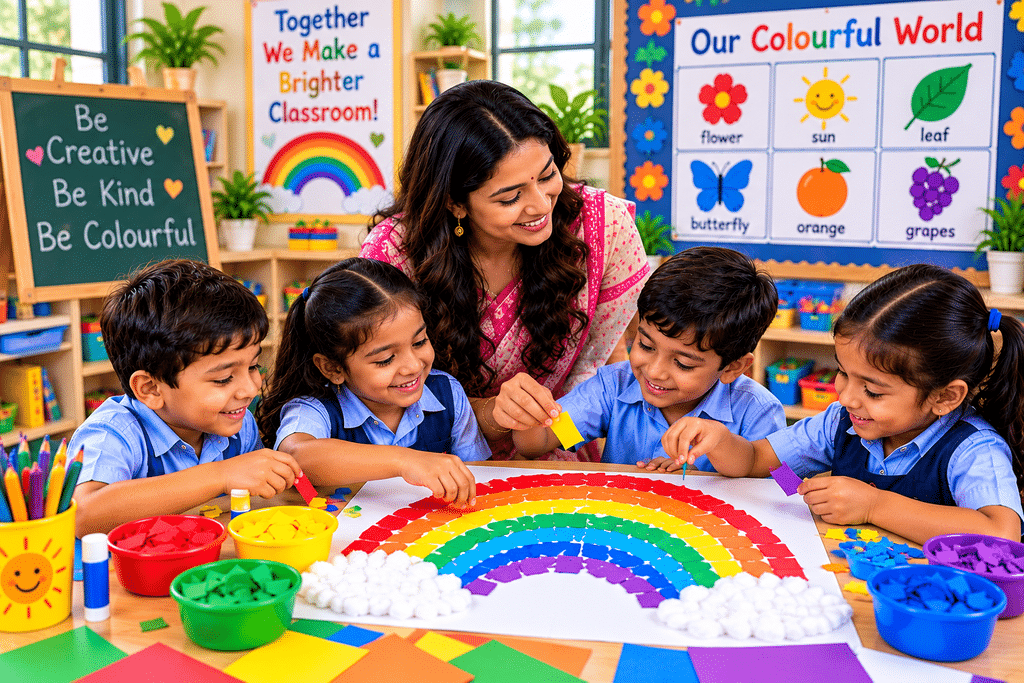
Colours can transform ordinary classroom objects into opportunities for discovery.
A handful of coloured bottle caps can become a mathematics lesson. A colourful leaf collection can inspire scientific observation. A simple picture card can support language development.
The most valuable classroom is not necessarily the one with the brightest walls. It is the classroom where every colour has a meaningful educational purpose.
When teachers combine colours with thoughtful instruction, hands-on experiences and inclusive teaching practices, children gain opportunities to explore, question, create and learn.
A colourful classroom becomes truly powerful when colours help children think.
Free Colour Learning Resources
Bring these ideas into your classroom with printable A4 resources for guided play and practice.
- Colour practice worksheets (A4 PDF)
- Colour play printables (A4 PDF)
- Colour learning charts (A4 PDF)
- The Colour Garden activity ebook (PDF)
- Download the complete colours pack (ZIP)
Print at actual size on A4 paper. Choose activities to suit each child’s readiness; pair colours with words, shapes and spoken instructions.
Browse colour worksheets · View all 5 cartoon charts and printables · Visit the ebook shelf