Before a child writes a name, a word, or a sentence, there is a small but meaningful beginning: making marks. A crayon moves across paper, a finger makes a circle in sand, or a brush leaves a long coloured line. These early movements deserve a place in our classrooms.
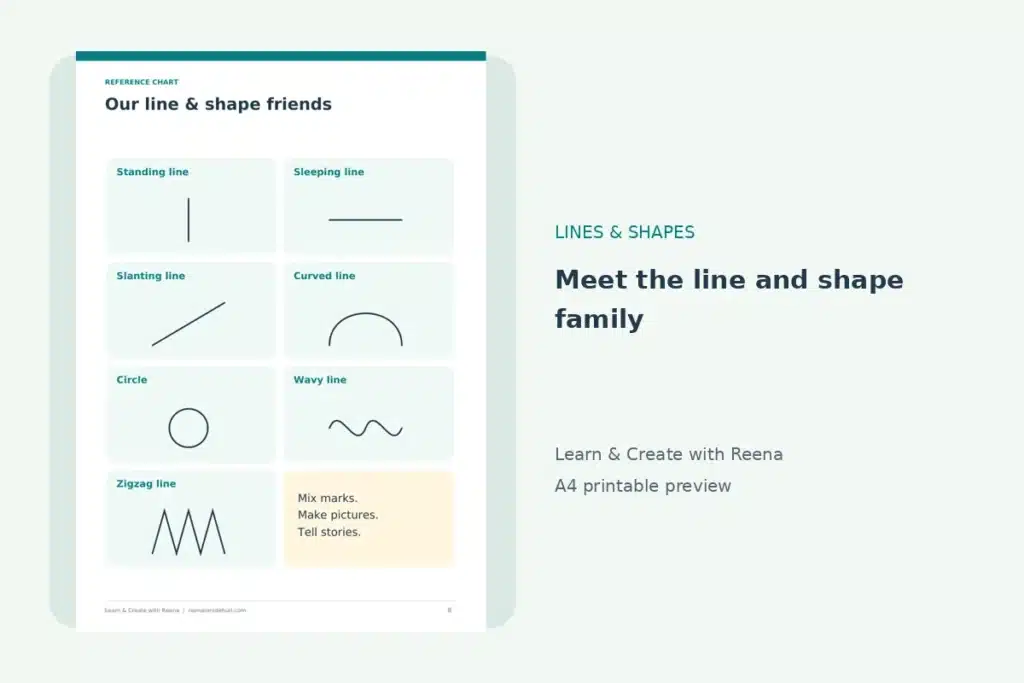
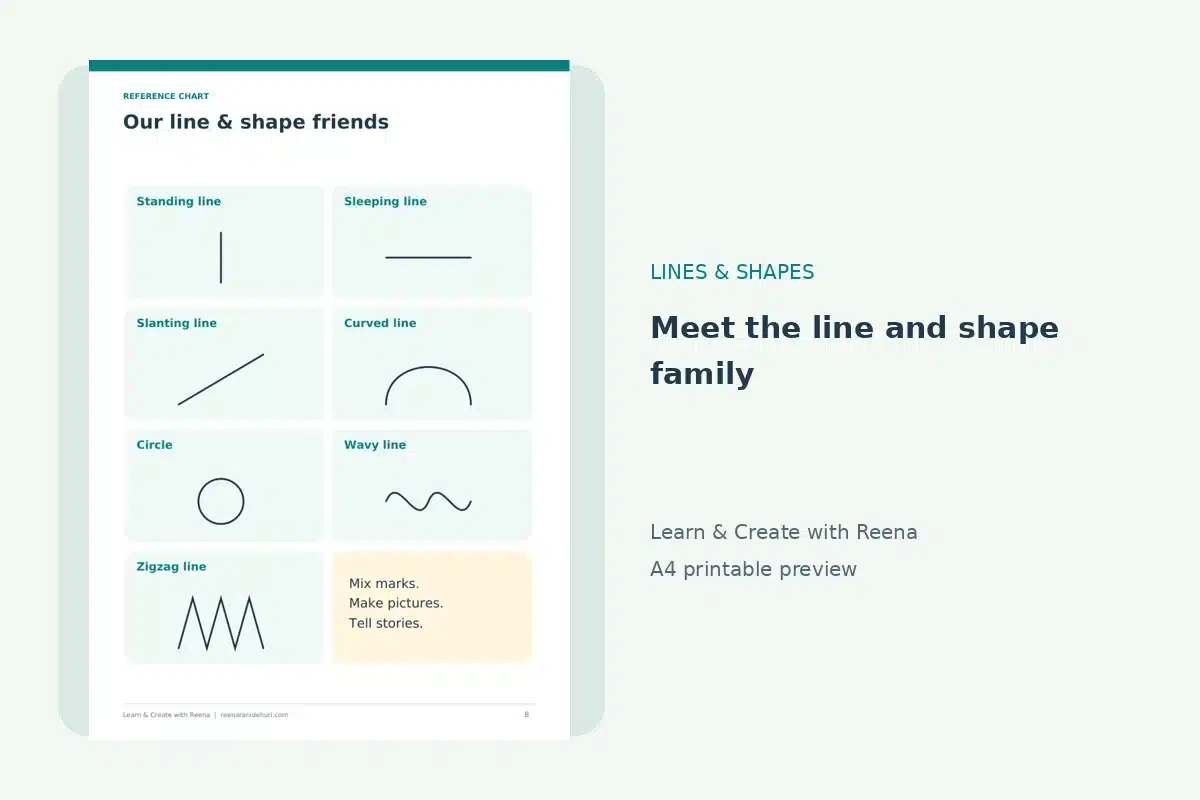
Standing lines, sleeping lines, slanting lines, curves, and circles are commonly included in pre-writing activities. They give children opportunities to explore how their movements create different marks. Over time, children learn to guide a drawing tool with greater intention.
As teachers, our responsibility is to make these experiences purposeful, enjoyable, and accessible.
What Are Pre-Writing Lines and Shapes?
Child-friendly names can make unfamiliar movements easier to discuss. Alongside these names, we can gradually introduce the mathematical vocabulary.
| Child-friendly name | Formal name | A familiar classroom example |
|---|---|---|
| Standing line | Vertical line | A tree trunk |
| Sleeping line | Horizontal line | A shelf |
| Slanting line | Diagonal line | The side of a roof |
| Curved line | Curve | A rainbow |
| Wavy line | Repeated flowing curves | Water waves |
| Zigzag line | Connected straight lines changing direction | Mountain peaks |
| Circle | A closed round shape | The outline of a wheel |
A circle is a shape rather than simply another kind of line. Children can explore this difference by noticing whether a path remains open or joins back to its beginning.
Small Movements Prepare Children for More Complex Tasks
Handwriting involves controlling a tool, choosing a direction, changing movement, and placing marks within a space. Drawing simple strokes gives children opportunities to practise these actions without the added challenge of remembering an entire letter.
For example, making a standing line involves moving in one direction. Drawing a circle involves continuing around and returning towards the starting point. A zigzag requires repeated changes of direction.
NHS occupational therapy guidance identifies pre-writing shapes as a foundation for developing the control needed for handwriting.
However, line practice alone does not teach literacy. Children also need conversation, stories, print, letter knowledge, and opportunities to communicate their own ideas.
Connect Each Movement with Something Meaningful
A page of repeated lines can quickly become mechanical. A picture gives the same movement a purpose.
Invite children to:
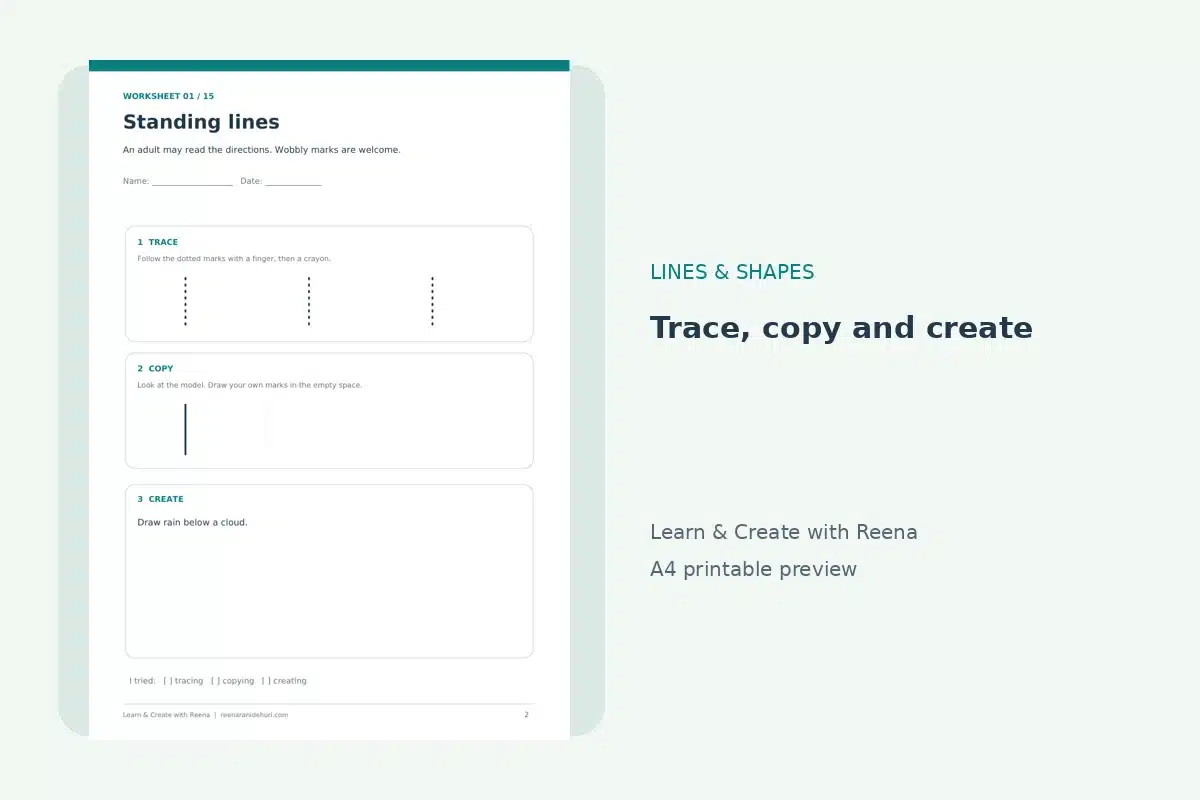
- Draw standing lines to make rain falling from a cloud.
- Add sleeping lines to create shelves in a shop.
- Draw curves to complete a rainbow.
- Make circles for wheels on a bus.
- Add slanting lines to finish a roof.
- Create a wavy river through an imaginary village.
These are suggested classroom activities. Their value lies in combining movement practice with choice, observation, and discussion.
Ask, “Where is your river going?” or “Who lives in this house?” Such questions allow children to explain their thinking.
Begin with Space to Move
Some children participate more comfortably when movements are large. Try drawing in the air, painting on a large sheet, or making chalk marks on a board before offering a smaller paper task.
Somerset NHS guidance recommends using movement to explore shape and direction as part of pre-writing experiences.
Large-scale activities also make it easier for a teacher to demonstrate a movement where everyone can see it. Children can then explore the same idea using different materials.
Use Tracing, Copying, and Independent Drawing
These activities offer different levels of support.
Tracing provides an existing path to follow.
Copying asks the child to look at a model and make a similar mark nearby.
Independent drawing asks the child to create the movement without an outline to follow.
A child who traces accurately may still find copying difficult. NHS guidance explicitly distinguishes tracing from drawing independently, so teachers should observe both rather than judge readiness from tracing sheets alone.
Offer a model, allow a supported attempt, and then provide blank space for exploration.
Make One Activity Work for Different Learners
In a mixed-readiness classroom, use a shared theme with different tasks. For a garden activity, one child might draw large stems, another might add circular flower centres, and another might draw a garden and label it.
An older child who needs extra movement practice can create a map, border, or illustrated sign. The task can support the same skill while respecting the child’s interests and age.
Do not make perfect shapes a condition for enjoying books, exploring letters, or attempting a name.
Observe Progress Beyond Neatness
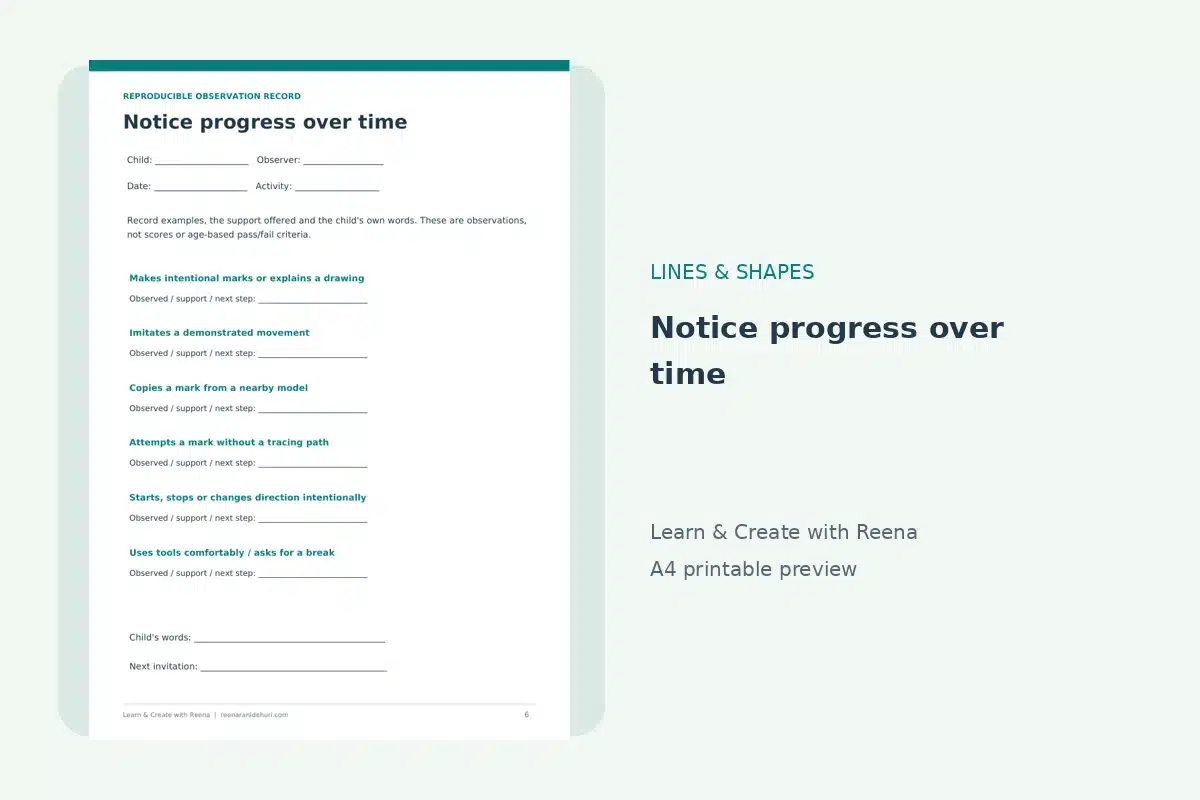
Useful observations include:
- Does the child make marks intentionally?
- Can the child imitate a movement?
- Is the tool comfortable to use?
- Can the child start and stop near an intended place?
- Does the child attempt a new movement?
- Can the child describe what the marks represent?
Keep occasional dated samples to notice change. Compare children with their own earlier efforts rather than with a classmate’s page.
Early writing includes drawing, symbolic marks, and attempts to communicate meaning. Teachers support this development when they invite children to record and share ideas. Read more in NAEYC’s guidance on emergent writing.
A child’s first lines deserve thoughtful attention. With suitable materials, meaningful activities, and patient teaching, those marks become opportunities to explore, create, and communicate.